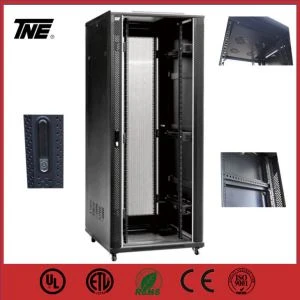

Network cabinet is a very common hardware device in data centers, computer rooms, and other fields, mainly used to store various network devices, such as routers, switches, servers, and so on. The scope of use of network cabinets is very extensive, involving various industries and fields. Below, we will provide a detailed introduction to the scope of use of network cabinets.
1. Data center
Data centers are one of the most widely used scenarios for network cabinets. In a data center, storage devices, servers, and network devices are usually placed in cabinets for easy maintenance and management. Due to the large number of these devices and their concentration in a single computer room, in order to avoid equipment interference, the network cabinet needs to have good sound insulation and heat dissipation performance to ensure the safe and stable operation of the internal equipment in the cabinet.
2. Communication field
In the field of communication, network cabinets are mainly used to store and manage base station equipment. A base station is the core of a mobile communication system, which can cover a large area and requires regular maintenance and management. If the base station equipment malfunctions, the entire communication system may be severely affected. By centralizing the base station equipment in the cabinet, it not only facilitates management, but also avoids faults and shortens repair time.
3. Security industry
In the security industry, network cabinets are used to store and manage monitoring equipment, video equipment, etc. Security equipment requires stable operation and uninterrupted operation for a long time. To avoid cable confusion or excessive space occupation caused by excessive equipment, using cabinets can effectively solve these problems and manage equipment in a neat and orderly manner.
4. Corporate Office
In enterprise offices, network cabinets are mainly used to store and manage devices such as servers, routers, switches, etc. For some large enterprises, it is common to have a large number of computers, servers, and network devices, all of which need to be connected to the network. By using cabinets, device stability can be improved and errors and malfunctions that may occur during information exchange can be reduced.
5. Academic institutions
In academic institutions, network cabinets are mainly used for storing and managing devices such as supercomputers. For some high-performance computers, a large amount of heat is generated during operation. If it cannot be dissipated in a timely manner, it can affect equipment stability and even cause damage. Using a network cabinet can provide a good cooling environment for devices, making their operation more stable and secure.
With the continuous development of the Internet era, the scope of use of network cabinets will also become increasingly widespread.